

Recently, the Singapore Police Force (SPF) announced that a 30-year-old woman was sentenced to 21 months’ imprisonment for money laundering-related offences and for failing to exercise reasonable diligence as a company director. She was also disqualified from acting as a director of companies in Singapore for five years following her release.
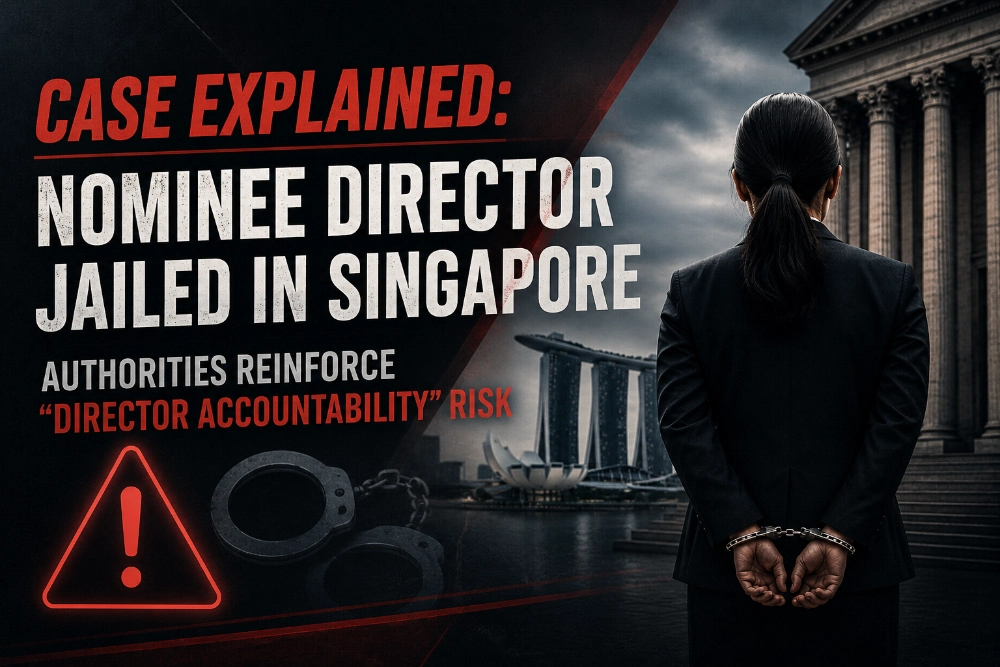
According to police investigations, the woman responded to a Telegram job advertisement in 2021 and agreed to act as a nominee director for several Singapore companies. She provided her personal particulars and SingPass login credentials to the individuals behind the arrangement. Subsequently, multiple companies were incorporated, with her appointed as the sole director and authorised signatory of the companies’ corporate bank accounts. In return, she received approximately S$2,000.
The police stated that one of the companies later received around CAD 400,000 in criminal proceeds linked to an unauthorised overseas bank transaction. During investigations, authorities found that the woman had reasons to suspect that the arrangement was abnormal and potentially illegal, yet she failed to exercise any supervision over the companies’ operations and financial activities. She was ultimately found to have facilitated the control of criminal proceeds and failed to fulfil her duties as a director.
What makes this case particularly important is that the authorities did not only pursue money laundering-related offences, but also relied on Section 157 of the Companies Act, which relates to a director’s duty to exercise reasonable diligence. In other words, even if a nominee director is not the actual controller of the company, failing to properly supervise the company may still result in criminal liability.
In recent years, similar cases have become increasingly common in Singapore. In the past, many people viewed nominee directors as merely “formal appointments,” while the actual operations were controlled entirely by clients. However, current enforcement trends clearly reject this mindset. Once an individual is appointed as a director, he or she is expected to genuinely discharge director responsibilities, including understanding the company’s business activities, monitoring bank account usage, identifying suspicious transactions, and ensuring that the company is not used for unlawful purposes.
More importantly for the CSP industry, investigations are no longer limited to nominee directors alone.
In other recent cases, CSP operators and company secretaries have also been investigated or charged alongside nominee directors. Authorities are increasingly looking into who arranged the nominee director, whether the CSP properly explained the director’s legal responsibilities, whether adequate supervision mechanisms existed, and whether AML/CDD obligations were genuinely fulfilled.
Some media reports have even mentioned cases where CSPs allegedly informed nominee directors that they did not need to actively supervise company operations, which later became part of the authorities’ basis for alleging that the CSP had facilitated director negligence.
This development is closely aligned with Singapore’s broader trend of strengthening AML/CFT enforcement. Under ACRA’s compliance guidelines, the responsibilities of a CSP go far beyond simply incorporating companies. CSPs are also expected to ensure nominee director arrangements are properly managed and that comprehensive AML/CDD due diligence and ongoing monitoring measures are implemented.
In the past, some practitioners believed that once documents were collected and forms were signed, any future misconduct by the client was no longer the CSP’s concern. Today, that mindset is becoming increasingly risky. Once a client becomes involved in money laundering, scams, suspicious fund flows, or other unlawful activities, authorities may investigate whether the CSP had acted negligently, implemented only superficial compliance measures, or failed to manage obvious risks appropriately. At that stage, the consequences may extend beyond ACRA regulatory actions and escalate into criminal investigations under legislation such as the CDSA and the Companies Act.
For Singapore’s CSP industry today, the real challenge is no longer simply “completing KYC.” The challenge is establishing a genuinely effective, defensible, and sustainable risk management framework that can withstand regulatory and law enforcement scrutiny.
AlgoCandy was built specifically for Singapore’s evolving CSP regulatory environment. Designed around the Singapore CSP Act, ACRA AML/CFT Guidelines, and ongoing monitoring requirements, AlgoCandy helps CSP firms establish standardised and auditable AML/CDD compliance workflows, allowing firms to strengthen compliance frameworks while balancing operational efficiency and customer experience.