

Recently, the Singapore Police Force (SPF) announced that siblings Lee Chia Yen (30) and Lee Ay Ling (33), former operators of Interconnect Consultancy Pte Ltd, were each sentenced to 10 months’ imprisonment for abetting nominee directors in breaching their director duties. Both were also disqualified from acting as company directors for five years.
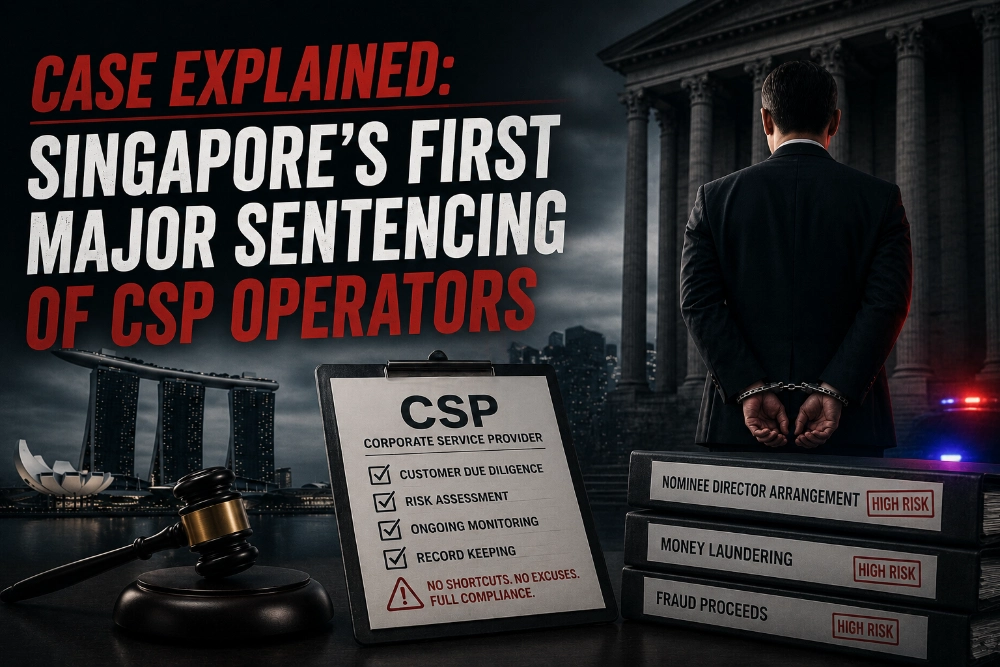
According to police investigations, the siblings operated Interconnect Consultancy, a Corporate Service Provider (CSP) firm in Singapore. Between June and September 2020, they incorporated 109 Singapore companies for foreign clients and recruited local residents through online advertisements to act as nominee directors in order to satisfy Singapore’s local director requirement.
Based on media reports and court disclosures, many of these clients were introduced through a China-based intermediary. Client passports, Chinese identity cards, business licences, KYC forms, and other supporting documents were largely collected and provided by the intermediary to the Singapore CSP.
Throughout the process, the Singapore CSP largely relied on information provided by the intermediary to complete company incorporations, nominee director arrangements, and bank account opening procedures. In some cases, the Singapore CSP never directly met, interviewed, or properly understood the clients themselves.
The case exposed two major compliance failures.
First, the CSP itself failed to properly conduct AML/CDD due diligence. According to reports, the checks performed by the CSP were extremely limited, mainly involving simple negative news searches and reviews of publicly available information relating to the clients’ Chinese companies. There was no proper independent verification of the clients’ background, business activities, source of funds, or the genuine commercial purpose for setting up Singapore companies.
Second, there were serious issues with the nominee director arrangements themselves. The police stated that the CSP operators effectively misled nominee directors into believing that they did not need to genuinely supervise the companies, understand the actual business activities, or monitor fund movements. Their role was reduced to signing documents, assisting with bank account opening, and merely satisfying the “local director” requirement.
The authorities considered this to be a deliberate “nominee but no supervision” arrangement, where nominee directors were effectively guided to abandon their legal director responsibilities while AML/CDD processes became largely superficial.
Ultimately, 16 out of the 109 companies were used to receive more than US$14.6 million in fraudulent funds linked to international Business Email Compromise (BEC) scams involving victims from Belgium, Chile, the United States, and Singapore.
This case sends a very clear message to the entire Singapore CSP industry:
Even if clients are introduced by intermediaries, and even if documents are collected by third parties, Singapore-based CSPs are still expected to personally conduct complete, genuine, and defensible AML/CDD checks, and remain fully responsible for client risks and nominee director arrangements.
From the perspective of law enforcement and regulators, the party carrying the legal responsibility is always the Singapore-licensed CSP itself.
Once a client later becomes involved in money laundering, fraud, suspicious fund flows, or other unlawful activities, the authorities are likely to investigate:
- Whether the CSP genuinely conducted AML/CDD;
- Whether the CSP truly understood the client’s business;
- Whether obvious risks were ignored;
- Whether ongoing monitoring mechanisms existed;
- Whether nominee director risks were properly managed;
- Whether compliance was merely superficial;
- Whether nominee directors were improperly guided to avoid supervision responsibilities.
If serious negligence, risk disregard, or facilitation of misconduct is identified, the consequences may go far beyond ACRA regulatory action and escalate into criminal investigations under legislation such as the Companies Act and the CDSA.
Importantly, the police also highlighted that this was the first CSP conviction following the Singapore High Court’s landmark judgment in PP v Zheng Jia. That judgment sent a strong signal that imprisonment — rather than fines — is increasingly becoming the default sentencing approach for professional directors and CSPs operating “nominee but no supervision” business models.
For today’s Singapore CSP industry, the challenge is no longer simply “completing KYC.” The real challenge is building a genuinely effective, defensible, and auditable AML/CDD framework capable of withstanding regulatory and law enforcement scrutiny.
Where clients present suspicious backgrounds, unclear business purposes, unusual fund flows, or other obvious red flags, CSPs should exercise caution and reject such clients where necessary, rather than lowering compliance standards for business purposes. For accepted clients, CSPs must also conduct continuous, genuine, and properly documented AML/CDD reviews, while maintaining a complete evidence trail.
AlgoCandy was built specifically for Singapore’s evolving CSP regulatory environment. Designed around the Singapore CSP Act, ACRA AML/CFT Guidelines, and ongoing monitoring requirements, AlgoCandy helps CSP firms establish standardized and auditable AML/CDD workflows, enabling firms to better manage nominee director risks, client risks, and ongoing monitoring obligations while balancing compliance, operational efficiency, and customer experience.