

As regulatory expectations for Corporate Service Providers (CSPs) in Singapore continue to increase, AML/CFT compliance is no longer a concern only for large institutions. For corporate secretarial firms, accounting firms, registered office address providers, and other businesses providing corporate services, completing customer due diligence and AML/CFT compliance work in an efficient, complete and provable way has become an important part of daily operations.
Many CSPs may ask: Do we really need AML/CFT compliance software? How should we choose one? What kind of software is truly suitable for Singapore CSPs?
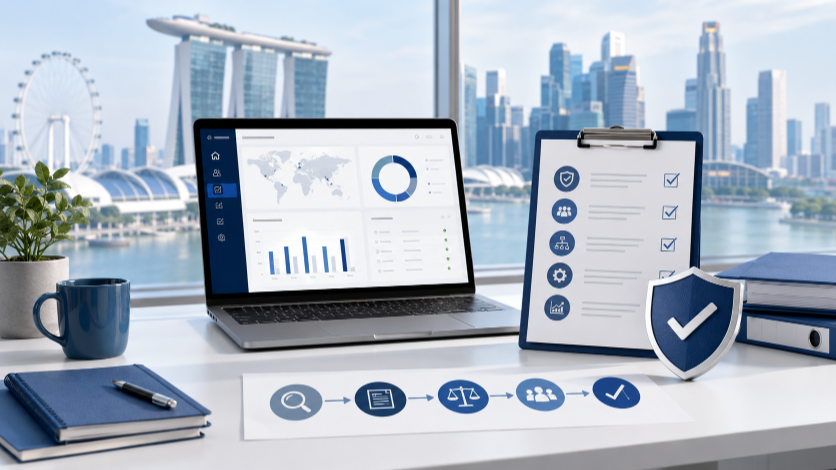
This article explains how CSPs can assess AML/CFT compliance software from the perspectives of compliance, efficiency, customer experience and actual workflow.
1. Why Do CSPs Need AML/CFT Compliance Software?
For Singapore CSPs, compliance risks generally come from two main areas.
The first is ACRA compliance review. ACRA may conduct reviews directly or through appointed third-party reviewers. These reviews may focus on IPPC, CDD, AML/CFT screening, customer risk assessment, staff training, record keeping and other compliance requirements.
The second is when a customer becomes involved in money laundering, fraud or other criminal risks, which may trigger investigations by the Singapore Police Force or other enforcement authorities. This type of risk is often more serious than a routine compliance review. If a customer is involved in illegal activity, the CSP may need to prove that it has properly conducted customer due diligence, identified risks, performed screening, obtained approvals and conducted ongoing monitoring.
Therefore, CSP compliance should not stop at “having documents”. A CSP must be able to prove whether each customer case has gone through a complete compliance process, whether the basis for risk judgment is clear, and whether records are traceable.
If everything is done manually, CSPs may face many practical problems:
- AML screening may be incomplete;
- Customers, directors, shareholders, authorised representatives and beneficial owners may be missed;
- PEP, sanctions and adverse media risks may not be updated in time;
- CDD questionnaires and customer information may require repeated follow-up;
- Professional terms may need to be repeatedly explained to customers;
- Staff may miss required steps or records;
- High-risk customers may lack a clear approval trail;
- It may be difficult to prove afterwards that compliance obligations were properly fulfilled.
For CSPs that care about compliance, efficiency and customer experience, AML/CFT compliance software is not simply an additional cost. It is an important tool for reducing risk, saving time and improving professionalism.
2. Do Not Look Only at AML Screening — Look at the Complete CDD Workflow
When choosing compliance software, many CSPs focus mainly on one function: AML screening.
AML screening is important, but it is only one part of the overall AML/CFT compliance process. Software that is truly suitable for CSPs should not be merely a “name screening tool”. It should support the complete CDD workflow.
A complete CSP AML/CFT compliance workflow usually includes:
- Customer onboarding;
- Customer information collection;
- Information collection for authorised representatives, directors, shareholders and beneficial owners;
- Customer declarations and KYC/CDD questionnaires;
- Identity verification;
- AML/CFT screening;
- Customer risk assessment;
- Enhanced due diligence for high-risk customers;
- Internal approval and review;
- CDD reports and record keeping;
- Ongoing monitoring and periodic review.
If a software product can only perform AML screening, but cannot help the CSP collect customer information, complete CDD questionnaires, verify identity, assess customer risk, record approvals and conduct ongoing monitoring, then it only solves part of the problem. It cannot truly replace a manual workflow.
When selecting a system, CSPs should ask: Can this software help us complete the full compliance workflow, rather than just one step?
3. Whether the Software Fits Singapore CSP Business Scenarios
AML/CFT software designed for different countries and industries may follow very different logic. Banks, payment institutions, virtual asset service providers, law firms, accounting firms and CSPs do not operate under exactly the same compliance workflow.
Singapore CSPs have their own business characteristics, such as:
- Customers often involve multiple roles, including companies, shareholders, directors, UBOs and authorised representatives;
- Company incorporation, corporate secretarial services, registered office address services, nominee directors and nominee shareholders carry specific risks;
- CDD procedures need to align with ACRA’s expectations;
- Customer information and company structures need to be maintained over time;
- CSPs must be able to prove that they have performed customer due diligence and risk assessment;
- Customer experience is important, because many customers are not financial compliance professionals.
Therefore, CSPs should not choose only a generic AML tool. They should prioritise whether the system is truly suitable for Singapore CSP workflows.
A system suitable for CSPs should understand company structures, member relationships, UBO identification, KYC/CDD forms, corporate services workflows and the compliance records required in daily CSP operations.
4. Whether It Improves Customer Experience
One of the biggest pain points in CDD work is customer experience.
Many customers do not understand terms such as CDD, UBO, PEP, Source of Funds and Source of Wealth. They may not understand why a CSP needs to request so much information. If the CSP relies entirely on manual communication, customers may feel that the process is complicated, repetitive and inefficient. Some may even question the CSP’s professionalism.
Good AML/CFT compliance software should help CSPs improve customer experience, for example:
- Customers can complete information online;
- The questionnaire process is clear;
- Professional terms are properly explained;
- Document upload is convenient;
- Electronic declarations or signatures are clearly presented;
- Customers do not need to repeatedly provide information by email;
- CSPs can reduce repetitive communication;
- Customers can feel that the process is professional, standardised and trustworthy.
For CSPs, customer experience is not just a nice-to-have. If the CDD process is too complicated, customers may become frustrated or even leave. Therefore, when choosing software, CSPs should not only review backend functions, but also test the customer-facing experience.
5. Whether It Reduces Manual Work Instead of Adding More Work
One of the core values of compliance software is to reduce manual work, not to create another layer of work for employees.
Some software products appear to have many features, but in actual use they may still require extensive manual data entry, repeated uploads, manual report preparation and manual screenshots. This can increase staff workload instead of reducing it.
When testing software, CSPs should pay close attention to whether the system:
- Reduces repeated data entry;
- Automatically generates records;
- Integrates customer information, screening results and risk assessment;
- Exports complete CDD reports;
- Supports ongoing monitoring reminders;
- Helps staff complete a customer case faster;
- Helps compliance managers review cases more easily.
Good compliance software should allow staff to spend less time on repetitive work and more time on risk judgment and customer service.
6. Whether It Creates a Complete Compliance Evidence Trail
When choosing AML/CFT compliance software, CSPs must pay particular attention to the compliance evidence trail.
Compliance is not only about performing certain actions. It is also about being able to prove later:
- When customer information was collected;
- Who submitted the information;
- What declarations the customer made;
- What AML/CFT screening was conducted;
- How screening results were reviewed;
- How the customer risk rating was determined;
- Whether approvals were obtained;
- Whether ongoing monitoring was conducted;
- Whether proper records were kept;
- Whether a complete report can be exported.
If ACRA conducts a review in the future, or if a customer becomes involved in money laundering, fraud or other risk events, the CSP must be able to provide complete, clear and traceable records.
Therefore, compliance software should not only help CSPs “complete the work”. It should also help CSPs “keep the evidence”.
7. Whether It Supports Ongoing Monitoring and Periodic Review
CDD is not a one-time task. During the customer relationship, shareholders, directors, UBOs, business activities, country risks, PEP status, sanctions risks and adverse media may change.
Therefore, AML/CFT compliance software should support ongoing monitoring and periodic review, such as:
- Periodic customer review reminders;
- Ongoing monitoring of changes in AML screening results;
- Document expiry reminders;
- More frequent review reminders for high-risk customers;
- Records of each review and follow-up action.
If the software only performs screening at onboarding and cannot support ongoing monitoring, its value for long-term compliance management will be limited.
8. How to Assess Whether a Software Is Suitable for CSPs
When choosing AML/CFT compliance software, CSPs can start by asking the following questions:
- Is it designed for Singapore CSP scenarios?
- Does it cover the complete CDD workflow?
- Does it support not only AML screening, but also customer information collection, identity verification, risk assessment and report export?
- Does it reduce manual communication and repeated data entry?
- Does it improve customer experience?
- Does it create complete compliance records and evidence trails?
- Does it support ongoing monitoring and periodic review?
- Is it easy to use, and will staff be willing to use it?
- Can it help the CSP deal with ACRA reviews and customer-triggered risk events?
- Does it fit the CSP’s budget and long-term business needs?
If a software product does not solve the main pain points in actual operations, then even if its feature list looks impressive, it may not be the right choice for CSPs.
9. Why We Recommend AlgoCandy
AlgoCandy is a one-stop AML/CFT compliance software designed for Singapore CSPs. It is not simply an AML name screening tool. Instead, it helps CSPs build a complete, online, efficient and traceable CDD workflow.
Key features of AlgoCandy include:
1. Designed for Singapore CSPs
AlgoCandy’s workflow is built around the actual needs of Singapore CSPs, including corporate secretarial firms, accounting firms, registered office address providers and other corporate service providers.
It focuses not only on AML screening, but also on the full needs of CSPs in customer acceptance, KYC/CDD, identity verification, risk assessment, ongoing monitoring and record keeping.
2. Covers the Complete CDD Workflow
AlgoCandy supports the full process from customer onboarding to ongoing monitoring, including customer information collection, KYC/CDD questionnaires, identity verification, AML screening, customer risk assessment, approval records and CDD report export.
This helps CSPs avoid scattering customer information, screening records, risk assessments and reports across multiple tools or folders.
3. Improves Efficiency and Reduces Manual Work
Through online workflows and systemised management, AlgoCandy helps CSPs reduce the time spent repeatedly requesting customer information, explaining procedures, manually organising information and preparing reports.
For staff, the system helps guide them through the required workflow and reduces the risk of missing compliance steps.
4. Improves Customer Experience
Customers can complete information submission, document upload, identity verification and relevant declarations through an online process, reducing back-and-forth email communication and repeated explanations.
For customers, the process becomes clearer, more professional and easier to understand.
5. Helps Build Complete Compliance Records
AlgoCandy helps CSPs integrate customer information, AML screening, risk assessment, ongoing monitoring and report records into one workflow, creating a more complete compliance evidence trail.
This is valuable for future ACRA reviews, internal reviews and customer-triggered risk events.
6. Balances Compliance, Efficiency and Customer Experience
Many tools focus only on screening or forms. However, what CSPs truly need is a platform that balances compliance completeness, team efficiency and customer experience.
AlgoCandy’s value lies in integrating these processes into a workflow that is better suited to Singapore CSPs.
10. Final Advice: Compare, Watch Demos and Test the Workflow
Every AML/CFT compliance software provider will say that their system is the best. However, the software that is truly suitable for a CSP cannot be selected only based on a sales presentation or a feature list on a website.
Before making a decision, CSPs should:
- Compare the actual workflows of different systems;
- Watch a complete demo;
- Personally test the customer onboarding process;
- Test AML screening, risk assessment and report export;
- Involve the staff who will actually use the system;
- Assess whether the customer-facing experience is clear and user-friendly;
- Judge whether the system truly saves time;
- Check whether it covers the CSP’s core compliance requirements;
- Decide whether it helps the firm build complete compliance records.
The best software is not necessarily the one with the loudest marketing. It is the one that best fits the CSP’s actual business, reduces compliance risk, improves efficiency and provides a better customer experience.
For Singapore CSPs, the key question when choosing AML/CFT compliance software should be:
Does this software truly help us make our compliance workflow complete, efficient and provable?
If the answer is yes, then it is a system worth considering for long-term use.