

In Singapore, a Corporate Service Provider (CSP) refers to a person or business that provides specified corporate services to others. Under the Corporate Service Providers Act 2024, businesses providing such services are generally required to register with ACRA as a CSP before they can legally provide corporate services.
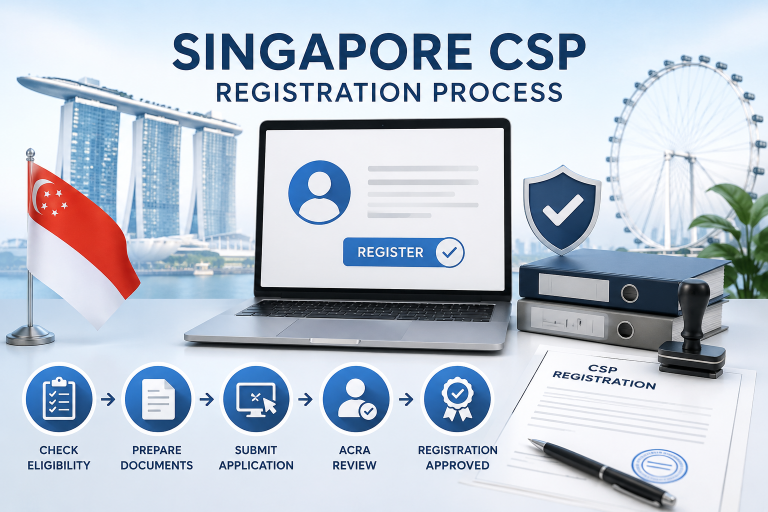
This article summarises the key registration requirements, process, fees, and important points to note.
1. Who Needs to Register as a CSP?
A business generally needs to register as a CSP if it provides any of the following corporate services to clients:
1. Business Registration Services
Setting up companies or other legal entities for clients.
2. Address Services
Providing registered office addresses, business addresses, correspondence addresses, shared office addresses, or virtual office services for business entities.
3. Role Services
Acting as, or arranging for others to act as, company directors, company secretaries, partners, or similar roles in other legal entities.
4. Nominee Shareholder Services
Acting as, or arranging for others to act as, nominee shareholders.
5. Designated Accounting Services
Providing accounting, tax, internal audit, or management accounting services while carrying out designated activities for clients, such as managing client assets, bank accounts, legal entities, or business transactions.
6. ACRA Filing Services
Filing ACRA transactions on behalf of others, including annual returns, updates to company information, and maintenance of company records.
Businesses that only file for their own entity, group companies, or merely refer clients to registered CSPs may not need separate CSP registration. However, each business should assess its actual services against ACRA’s requirements.
2. Key Eligibility Requirements for CSP Registration
Before applying to register as a CSP, the applicant must generally meet the following key requirements.
1. The Business Must Be Registered with ACRA
The applicant must be an ACRA-registered business entity, such as:
- Business / Sole Proprietorship
- Company
- Limited Liability Partnership (LLP)
- Limited Partnership (LP)
2. The CSP Must Have at Least One Registered Qualified Individual
The applicant must meet one of the following requirements:
- The applicant is a Registered Qualified Individual (RQI);
- At least one partner is an RQI; or
- The business employs or engages at least one RQI.
After registration, the CSP will usually rely on its appointed RQI to carry out filing transactions for clients.
3. Relevant Persons Must Meet Fit and Proper Requirements
ACRA will consider whether the directors, partners, and persons directly or indirectly involved in the management of the CSP meet the “fit and proper” requirements.
The applicant will need to make relevant declarations during the registration process. ACRA may also review the applicant’s conduct, compliance history, professional misconduct records, and commercial integrity.
4. Mandatory AML/CPF/CFT Training and Proficiency Test
At least one director, owner, or partner must complete the prescribed AML/CPF/CFT training course and proficiency test within six months before the application.
Although RQIs and ordinary CSP employees are not required to complete this training for registration purposes, CSPs may still arrange training for relevant staff as part of their internal compliance obligations.
3. CSP Registration Fees and Related Costs
The ACRA registration fee for a CSP is S$400 for two years.
This fee is non-refundable, even if:
- The application is rejected;
- The CSP de-registers early; or
- ACRA cancels the CSP registration.
Payment can be made by credit card, debit card, or online banking.
In addition to the registration fee, applicants should also take note of the mandatory AML/CPF/CFT training and test costs:
- AML/CPF/CFT course fee: S$200
- AML/CPF/CFT proficiency test fee: S$45 per attempt
CSP registration must be renewed before expiry. The renewal fee is also S$400, and the renewed registration is generally valid for two years from the date of approval.
4. CSP Registration Process
The CSP registration process is completed through Bizfile. The key steps are as follows.
Step 1: Confirm Whether CSP Registration Is Required
The business should first assess whether it provides any regulated corporate services, such as company incorporation, company secretarial services, address services, nominee services, or ACRA filing services.
If the business provides such services to clients, it should complete CSP registration before carrying on the relevant business.
Step 2: Prepare the Required Information
Before submitting the application, the applicant should prepare:
- The types of corporate services provided;
- The nature of the business;
- The identification type and number of each appointed RQI;
- Mandatory AML/CPF/CFT training and proficiency test records;
- Relevant declarations on fit and proper requirements.
Step 3: Submit the Application via Bizfile
The applicant must log in to Bizfile as a representative of the CSP, complete the required information, declare that the relevant persons meet the fit and proper requirements, appoint at least one RQI, submit the filing, and pay the registration fee.
Step 4: Obtain RQI Endorsement, If Applicable
If more than one RQI is appointed, all appointed RQIs must endorse their appointment, except for the RQI who submitted the application.
The appointed RQI will need to log in to Bizfile and accept the appointment.
Step 5: ACRA Review and Approval
ACRA will review the application before approval. The review may include the applicant’s conduct and compliance history, professional misconduct issues, commercial integrity, and understanding of terrorist designation legislation and targeted financial sanctions.
Most applications are processed within 30 working days. ACRA will notify the applicant if more time is required.
Step 6: Obtain CSP Number and Add Clients
Once the application is approved, the CSP will receive a unique CSP number.
To file transactions for clients, the CSP must log in to Bizfile using the CSP profile and add its clients before filing transactions on their behalf.
5. Important Points to Note After Registration
CSP registration is not just a one-time filing. After registration, CSPs must continue to meet regulatory and compliance obligations.
1. Maintain Ongoing Compliance
Registered CSPs must comply with the CSP Act 2024, related regulations, and ACRA’s requirements.
2. Establish AML/CPF/CFT Compliance Procedures
CSPs should have proper internal procedures for customer due diligence, risk assessment, sanctions screening, ongoing monitoring, record keeping, and escalation of suspicious matters.
3. Keep RQI and Client Information Updated
CSPs should ensure that appointed RQIs, client lists, employee filing access, contact details, and corporate service types remain accurate and updated.
4. Renew Registration on Time
CSP registration must be renewed before expiry. If the registration expires, the CSP may lose the ability to file transactions for clients. If the registration is not renewed within the required period, the CSP may need to submit a new application and pay the application fee again.
5. Understand the Risk of Non-Registration
If a business is required to register as a CSP but fails to do so, it cannot legally provide corporate services and may face regulatory penalties.
Conclusion
Registering as a CSP in Singapore is not merely an administrative filing. A business must first determine whether its services fall within the regulated scope, ensure that it has at least one RQI, meet fit and proper requirements, complete the mandatory AML/CPF/CFT training and test, and submit the registration through Bizfile.
For corporate secretarial firms, accounting firms, address service providers, and other businesses providing corporate services, CSP registration is an important regulatory foundation. Before applying, businesses should review their service scope, personnel qualifications, internal compliance procedures, and ongoing obligations to ensure that they can continue to meet ACRA’s requirements after registration.